Practical guides to the decisions, rules and public records that affect everyday life in Ireland. Clear answers, official sources and no political spin.
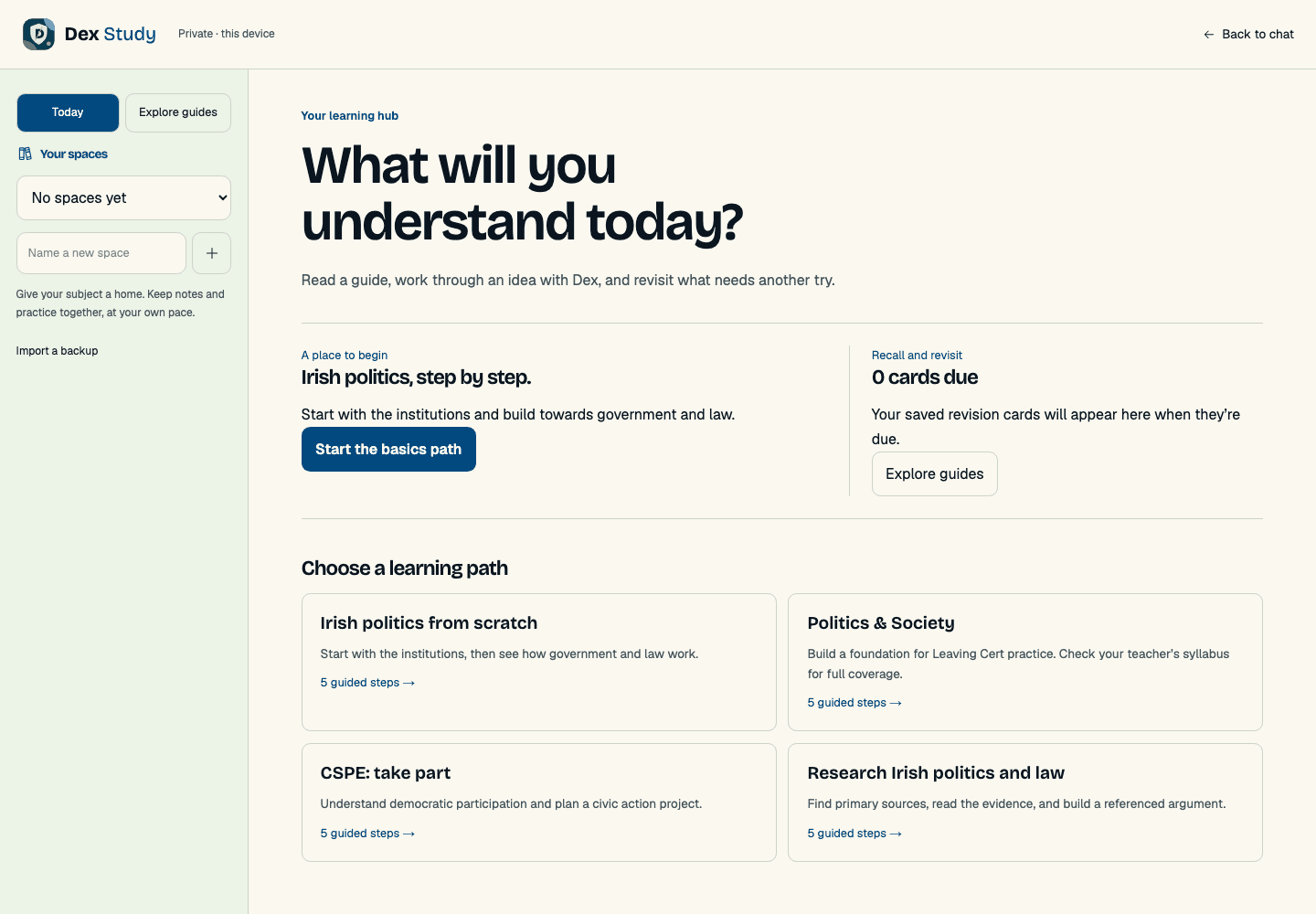
VoteFor teachersDon’t Just Teach the Dáil. Let Your Students Check Its HomeworkDáil contributionFor university studentsYour Lecturer Will Ask Where That Came From: Dex vs ChatGPT, Gemini, Claude and GoogleParliamentary questionNew from DáilDexIntroducing Dex Study: a place to build understanding
Study saves to your DáilDex account, so you can start on a laptop and revise on your phone. It now has exam-style papers, a hint-by-hint tutor, a real writing desk and a Bill Explorer. Claim October’s offer for GPT 6.1 Sol, GLM 5.3 and more in Study, without touching your Dex limits.
Real Oireachtas votes, debates and questions can open a lesson, anchor a week-long research project and mark a class practice test, with sources your students can open and check. Here is how teachers use Dex to do it.
ChatGPT, Gemini, Claude and Google are excellent at almost everything. Dex is built for one thing: Irish politics and law, with sources you can cite. An honest comparison for university students, and a deal: sign up with your university email and get three months of Dex Pro for €3 a month.
Ireland has a Taoiseach, not a President, running the country. How the Irish Dáil compares to Congress, how elections work, and what Americans usually get wrong.
How the Irish Dáil compares with Westminster: TD vs MP, Taoiseach vs Prime Minister, PR-STV vs first past the post, and why Irish politics looks familiar but works differently.
How Ireland's Dáil, Seanad and Taoiseach compare with Canada's House of Commons, Senate and Prime Minister, and how Irish PR-STV elections differ from first past the post.
How Ireland's PR-STV elections, Dáil and Seanad compare with Australia's preferential voting, House of Representatives and Senate, and why Tasmania is the closest match.
How Ireland's Dáil, Taoiseach and President compare with India's Lok Sabha, Prime Minister and President, plus voting rights and what newcomers to Ireland should know.
How Ireland's Dáil, Taoiseach and PR-STV elections compare with Germany's Bundestag, Chancellor and mixed-member proportional voting, and why Ireland has no 5% threshold.
A plain-English guide to Ireland’s courts, with a short film: the Constitution, the District, Circuit and High Courts, the Central Criminal Court, juries, the Court of Appeal and the Supreme Court, how laws are struck down, and how judges are appointed.
A DáilDex study of Ireland’s housing crisis in 2026: a €399,999 typical home, €1,839 new rents, one in three 25 to 29 year olds at home, a record 17,885 people in emergency accommodation, record completions and the gap to the Government’s 300,000-home target. Plus how we made Locked Out, our first narrated film.
A DáilDex study of the issues facing young people in Ireland in 2026: rent, living at home, homelessness, emigration, jobs and prices, climate, mental health and voting. Official figures, what’s behind them, the other side of each story, and what to watch in the Dáil.
A no-jargon guide for first-time voters in Ireland: how to register, what to bring on polling day, how to fill in the ballot 1, 2, 3, how PR-STV transfers work, and how to check what your TDs actually do. With our short film, First Vote.
Essay, project and dissertation ideas on Irish politics for Politics and Society, PPE, politics and law students, each paired with the primary sources that make a strong answer.
How Leaving Cert Politics and Society students can use Dáil debates, votes and parliamentary questions as evidence in the citizenship project, step by step.
How CSPE, Politics and Society and university students can use AI tools like Dex to understand Irish politics, check sources and revise, without handing over their own thinking.
A source-first method for comparing Sinn Féin and Fianna Fáil housing claims, policies and parliamentary records without inventing figures or reducing complex evidence to a scorecard.
What an Irish party manifesto is, how it differs from a programme for government and an election leaflet, and how to use each document without treating it as a legal record.
A practical, source-first method for comparing Irish party manifesto pledges by topic, detail and evidence—without collapsing different promises into a false ranking.
A clear guide to the roles of the HSE, the Minister for Health, the Department of Health and TDs when people ask who is responsible for hospital waiting lists.
Housing decisions involve national Government, local authorities, councillors, the planning system and TDs. This guide explains the different roles without oversimplifying them.
The difference between a TD, Senator and councillor in Ireland, including how each is chosen and what each can realistically do for local and national issues.
Not every Government defeat triggers an election. Learn the difference between an ordinary Dáil vote, a confidence vote and a vote that changes the Government's ability to govern.
A source-linked guide to the current Irish rules on Jobseeker’s Allowance and part-time work, including the conditions that still apply and where to check your own case.
Where to find the official national waiting-list data, what outpatient, inpatient and day-case figures mean, and why the numbers do not cover emergency care.
A practical overview of the official Social Welfare Appeals Office process, what to keep, the published time limits and why a TD cannot decide an appeal for you.
The latest official parliamentary analysis of Ireland’s fuel measures: which reductions were extended, what is scheduled to change from September, and what to check before sharing a pump-price claim.
A neutral explainer of the Government’s announced 2026 changes to social-housing eligibility: what the proposal says, what it does not decide by itself, and where to check the bill.
Ireland holds the Council of the European Union presidency from July to December 2026. Here is what the role actually involves, the published priorities and what it does not let Ireland do.
Government and Dáil are not interchangeable. This plain-English comparison explains who makes up each, how they relate, and why a Government still has to answer in the House.
The difference between an Irish bill and an Act, the stages in between, and why an announcement or a first-stage bill is not yet a rule you can rely on.
A comparison of Government bills and Private Members’ bills in Ireland: who introduces them, how they begin, and why the label does not predict the final law.
A practical, source-first way to compare Fianna Fáil and Fine Gael without turning party politics into a misleading scorecard or relying on undated labels.
Find the TDs who represent your constituency and understand what they can raise in the Dáil, what they cannot decide, and how to check their public record.
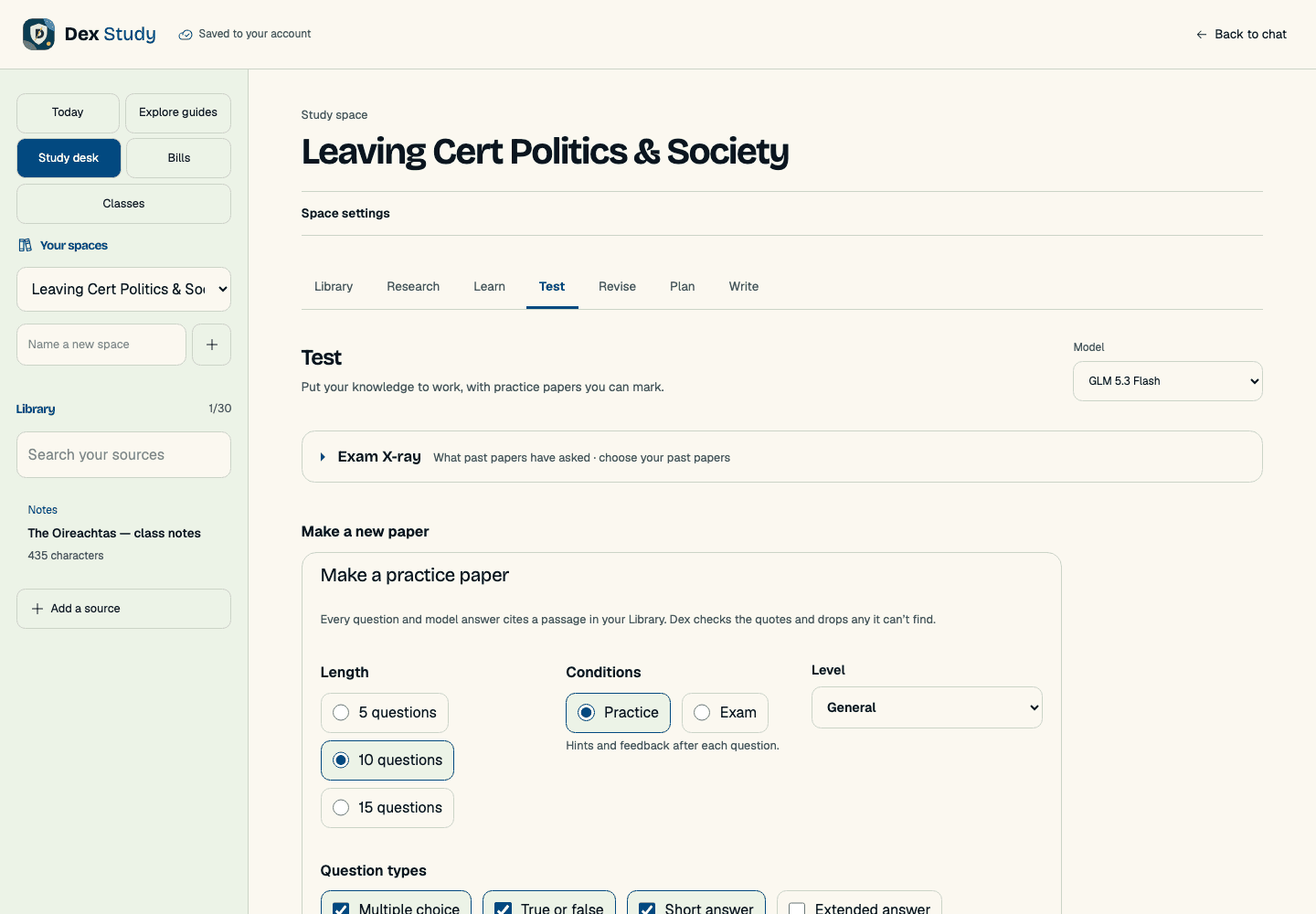
Dex now reads your exam papers and screenshots, shows licensed photos and short films, sets marked practice tests you can share, cites its sources down to the quote, and runs on GLM 5.3 Flash, a fast model hosted in Europe.
How Dex uses GPT 6.1 Sol, Claude Opus 5.5, Sonnet 5.5, Kimi K3, Qwen 3.8 Max Prime and Gemini 3.8 Flash, what their specs mean for civic questions, and why we offer a choice.
Sign in to Dex between 29 September and 5 October 2026 and Dex Pro is free: Claude Opus 5.5, GPT 6 Astra, GPT 6.1 Sol, Kimi K3, Claude Sonnet 5.5, and six newly added models.
DáilDex is live. Free, source-linked alerts when your TD votes, speaks or asks a question, plus Dex, our Irish civic AI. What it does, why we built it, and who helped.
Everything we shipped this season: Dex Pro with GPT 6 Astra and Claude Opus 5.5, interactive answers, daily source-checked news, 40+ Learn guides, a students hub and a redesigned site.
Dex can optionally sync civic chats to help LeemerLabs train a compact open Irish–English model. What we store, why it is opt-in, and how your data stays under your control.
Dex is DáilDex’s free, no-login Irish civic AI. Ask about TDs, votes, debates and bills with four free models, official Oireachtas lookups and private local chat history.
Every vote and speech in the Dáil is technically public. Almost none of it is actually visible. Here's why that gap is the real accountability problem, and what closes it.